Architecture Overview
StornX is a single controller Pod that orchestrates two cooperating engines - OptiScaler and OptiBalancer - driven by a cron loop and fed by Prometheus, the Kubernetes API and (optionally) Kube-NetLag.
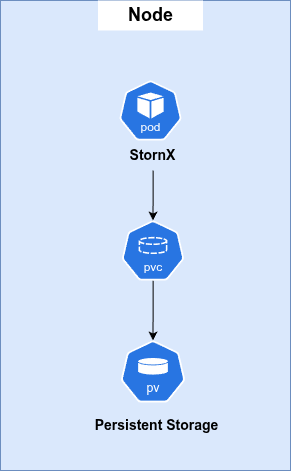
High-level dataflow
The two engines at a glance
| Engine | Question it answers | Output |
|---|---|---|
| OptiScaler | Does this Deployment need more or fewer replicas, and on which node should they live? | Pod create / delete via the K8s API |
| OptiBalancer | Given the current set of replicas, how should incoming traffic be split between them? | Patched Istio DestinationRule weights |
They run in the same cycle, in this order:
- OptiScaler first - placement changes the universe of replicas.
- OptiBalancer second - once the new layout is known, traffic is redistributed.
When OptiScaler creates or deletes a Pod, it writes a small marker on disk so that OptiBalancer knows the next cycle is "post-scaling" and should re-evaluate weights more eagerly.
The single-instance design
StornX runs as exactly one replica. This is deliberate:
- The decisions are global (placement + routing) - two instances racing would produce contradictory
DestinationRulewrites and oscillating Pod creation. - A single Pod is trivially leader-elected (
replicas: 1) and is cheap to run (it spends most cycles idle). - If the StornX Pod dies, Kubernetes restarts it; the only consequence is a missed optimization cycle. Your applications continue to serve traffic exactly as before.
Adapter layer
All interactions with the outside world go through a thin adapter layer so the core logic stays pure and unit-testable:
| Adapter | Wraps |
|---|---|
prometheus/* | PromQL queries for CPU, memory, request rate, P95, service graph |
k8s/* | Typed access to Pods, Deployments, Nodes, HPAs, PDBs, DestinationRules |
filesystem/* | The inter-cycle "scaling happened" marker file |
This is why the tests for OptiScaler and OptiBalancer run with zero mocks of Kubernetes - the adapter boundary is the only seam that needs replacing.
Where the components sit in the codebase
scheduler/
└── src/
    ├── cronjobs/            ← Cron engine, the entry point of every cycle
    ├── core/
    │   ├── optiScaler/      ← Placement + scale up/down logic
    │   └── optiBalancer/    ← Traffic-weight calculation + DR patcher
    ├── adapters/
    │   ├── prometheus/      ← PromQL queries
    │   ├── k8s/             ← Kubernetes API wrappers
    │   └── filesystem/      ← Cross-cycle markers
    └── config/              ← Env config, logger, K8s client
The hierarchy is intentional: core/ knows nothing about Kubernetes or Prometheus. It only consumes the typed interfaces in adapters/. Everything that talks to the outside world is replaceable.
What gets written into the cluster
StornX needs surprisingly few API verbs:
| Resource | Verbs |
|---|---|
pods | get, list, delete, create |
deployments | get, list, patch (scale) |
nodes | get, list |
hpa | get, list (read-only - to detect) |
pdb | get, list (read-only - to respect) |
destinationrules | get, list, patch |
The Helm chart ships RBAC that grants exactly this set, scoped to the configured namespaces.
What happens when things go wrong
| Failure | StornX behaviour |
|---|---|
| Prometheus unreachable | The cycle is skipped, structured WARN log, retried next cycle |
| Istio not installed | OptiBalancer disables itself; OptiScaler continues alone |
| Kube-NetLag absent | Latency-aware placement falls back to "same zone = best" |
| Target Pod has no metrics yet (cold) | Deployment is ignored this cycle (no garbage decisions) |
| StornX Pod itself crashes | Kubernetes restarts it - no application traffic is affected |
Next, dive into each engine: OptiScaler and OptiBalancer.